Emergent Photons and Confinement: A Numerical Study on \(\mathbb{Z}_N\) Lattice Gauge Theory
Physical Review Letters 135, 221901 · 2025
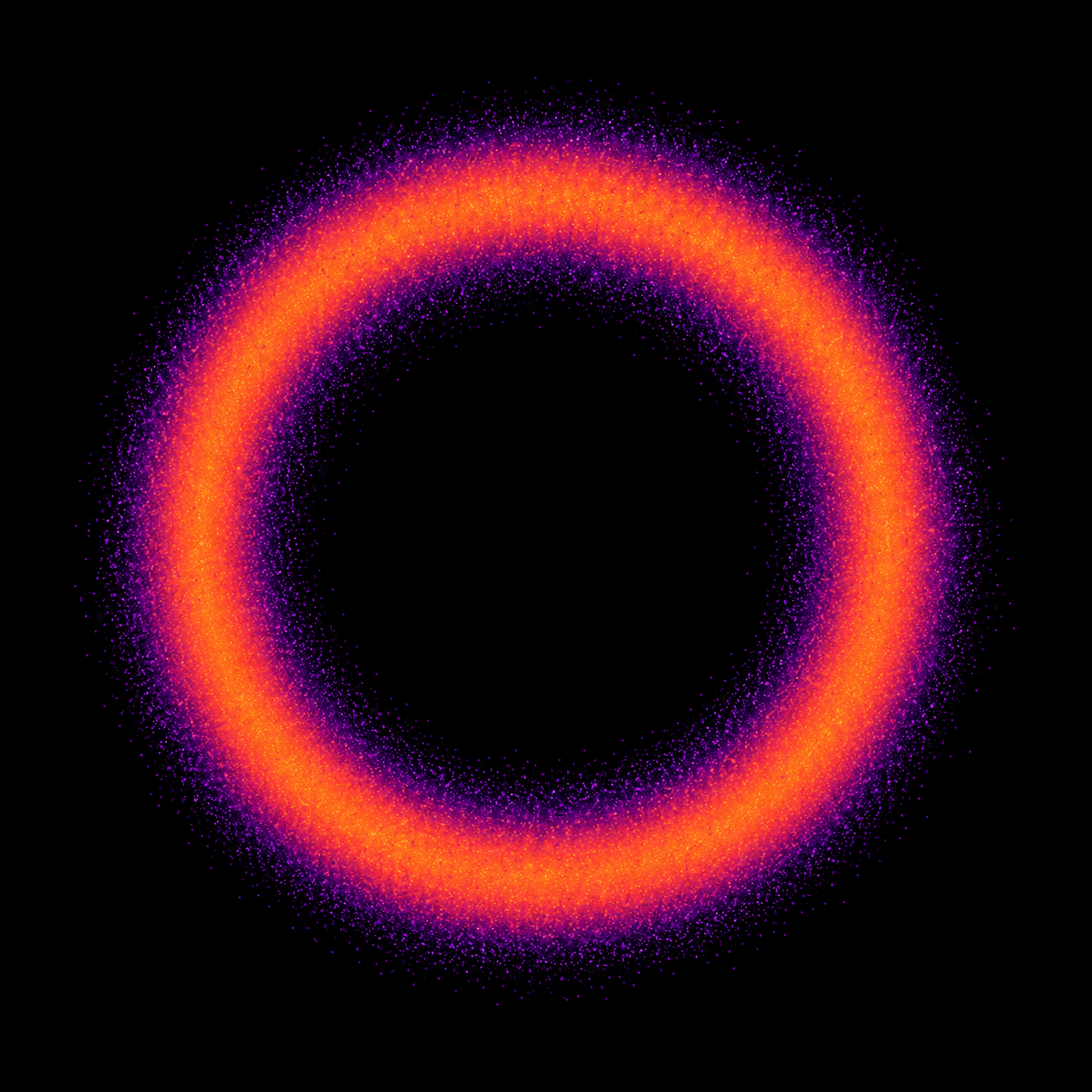
This work studies four-dimensional \(\mathbb{Z}_N\) lattice gauge theories as a setting in which discrete microscopic structure can give rise to emergent continuous behaviour. While photon phases are already known to occur for sufficiently large \(N\), we show that by explicitly suppressing monopoles, even very small finite gauge groups such as \(\mathbb{Z}_3\) and \(\mathbb{Z}_4\) can support an emergent massless photon. This makes the role of topological defects particularly transparent: center vortices alone do not distinguish the confined and photon phases, whereas the proliferation of vortex junctions, or monopoles, controls the transition between them. The model therefore gives a concrete example of how defect topology and symmetry determine large-scale behaviour in a discrete system.
Explore the vortices and monopoles of \(\mathbb{Z}_7\) lattice configurations.
Loading the lattice recording…
Choose between three saved Z₇ configurations: β = 0.1, 1.2, or 2.5, all with λ = 0. The β = 1.2 and β = 2.5 recordings have 10 × 10 × 10 × 10 lattices; β = 0.1 has a 6 × 6 × 6 × 6 lattice. Each configuration includes every recorded time slice. Arrows indicate flux direction; periodic copies show the same cell repeated around its boundaries. This viewer uses a saved recording, rather than running a live simulation.